| Spider-Man 2 Review
Peter Parker, part-time photographer, part-time pizza delivery boy, part-time college student, and, oh yeah, part-time superhero, is back in a brand new game based on the Spider-Man 2 movie. Though Spider-Man video games are nothing new (dating back as far as the Atari 2600), this new entry into the series from Treyarch and Activision promises to do what no other Spider-Man game could... let you be Spider-Man. That is, control Spider-Man and effortlessly web-swing and fight using the same acrobatic stunts the movie shows off. Did they succeed? Read on to find out.
Game Features
- Control Spider-Man like never before with an all-new physics engine
- Relive the experience of the motion picture, with you in the role of Spider-Man
- Go deeper than the movie with an all-new side story, incorporating other classic Spider-Man friends and enemies
- Free-roam a small-scale recreation of Manhattan, which is huge by anyone's standards
- Discover random crimes and events as they happen, and take it upon yourself to set things right
- Explore the city top and bottom to win awards and collect secret tokens
- Upgrade Spider-Man's abilities as you play by collecting and spending Hero Points
- Normal and Easy web-swinging modes to make the game more approachable for all players
- Takes 24 memory card blocks for up to 3 save files
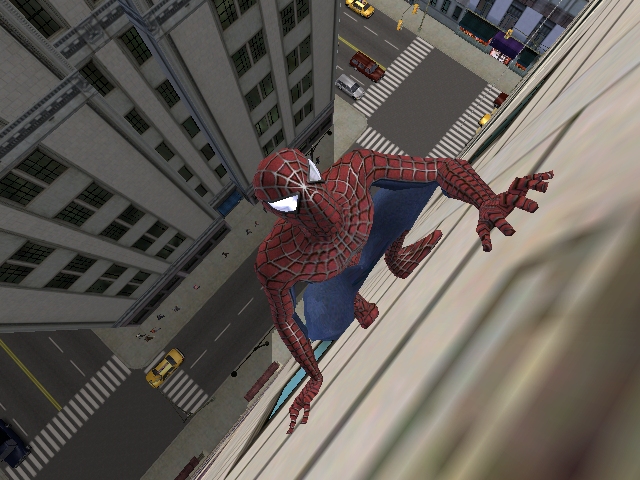 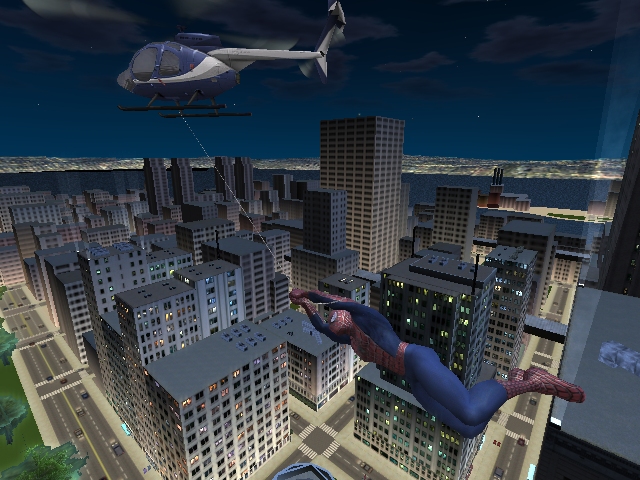
Considering the ridiculous popularity of the Spider-Man license, it would have been all too easy for Treyarch to rest on its laurels and churn out a Spidey-sequel that, despite the story upgrades, would have looked and felt the same as any Spider-Man game ever created – half-baked. The good news is that that isn't the way it happened at all. Enter Spider-Man 2, based on the blockbuster summer movie and an incredibly new experience for anyone, no matter how many Spider-Man games you played before it.
There are many changes to this game over the one released last year, but the most exciting of them all has to be the new physics system. Due to its' incredible design, you can now swing, jump, and fight just the way Spider-Man would. Jumping is the most basic maneuver, and yet it too has been on the receiving end of some major upgrades. Now, Spider-Man can do aerial tricks while jumping or falling that increase the distance of his jump ever so slightly, or charge his jump to unleash a high or long jump unrivaled by many other games. This function actually allows Spider-Man to jump from rooftop to rooftop just like he does in the movies, which is undeniably awesome. The charged jump also replaces the web zip from the first game when you're climbing the side of a building. Not only is faster and more efficient, it just looks cooler, while the web zip has been retooled to be even more useful – but more on that later. Movie fans will be especially pleased to know that this time around, Spider-Man has organic webbing for the first time instead of web cartridges. Organic webbing was disguised in the first game as an infinite webbing cheat, but this time there are no limits to what you can do, and zero threat of running out of the stuff.
Web-swinging is just what it was always meant to be: fast, accurate, and realistic (well, as realistic as a red and blue leotard-wearing guy shooting spider webs gets, anyway.) The new physics system makes it possible for the game to auto-calculate the highest and nearest place that Spider-Man can attach a web line to, whether it's the side of a building or the bottom of a helicopter. If nothing is above you, then you simply cannot web swing. However, because of the insane height of a majority of the buildings in the city (this is Manhattan, after all), that's rarely a problem. And even if nothing around you is suited for web swinging, as long as you're not out over the open water, you can usually attach a web line to a building once you fall past it. After all, not only can Spider-Man swing to the highest point of the Empire State Building, but he can also fight in the streets surrounding it and in any of the other streets in the city.
But what's best about the new swinging system is how gracefully Spider-Man can move around once you've had some time to practice. As long as you're within range of a good target, all you need to do is leap into the air, fire a web line, and you're on your way. But there's so much more you can do with it that it can be mind-boggling at first. The L button acts as a boost button, no matter where you are – and in the middle of a web-swing, it will also increase your speed. Spider-Man can also hop off a web line at any time, which actually increases your overall level of control. Once you begin to lose height, you can fire another web line to continue your momentum. And to deal with those pesky buildings that will inevitably get in your way as you reach street corners, there's the wallsprint maneuver, activated by holding L and pressing X as you reach the side of the building. In order to completely master web-swinging, you'll need to master simultaneously handling four buttons, and you'll have to press them in the right order, as doing otherwise will bring out other completely wrong but oh-so-useful Spidey-moves that are essential for other situations, so make sure you get it right.
Next come the physics that make web-swinging with Spider-Man just one stop short of actual flight. Because Spider-Man no longer automatically releases his web lines, he can literally perform a loop-the-loop if you manipulate the control stick correctly. As a result, Spider-Man can shoot straight forward, straight upwards, or directly backwards from any web line once you've got a good handle on the controls. You can even shoot a second web line in another direction to round corners quickly, or instantly stop yourself in mid-air if you hold onto both web lines. A player could spend hours just messing around with web-swinging and not be bored. It's easily one of the most fun things in the game.
As for the web zip, it is now used to propel Spider-Man through the air when he is above buildings. It's true that I said you can't web swing above buildings, and for good reason, but luckily this is the replacement. It must be purchased first, but once you've done that, there's no stopping Spider-Man from literally zipping around the city. Of course, it's not as fast as web-swinging, but if you're trying to reach a high target, it is often preferable to making a large drop for another web-swing attempt or slowly crawling or wallsprinting (by comparison only) up a building. The only possible problem with this maneuver is that it can be accidentally used when you try to web swing if you're not careful of which order you press the buttons in. This is a problem throughout the game no matter what you try to do, but it's a necessary evil in that you'd either have to accept reduced functionality in the game or a game controller with 20 or so buttons on it to avoid it. However, once you get used to the control scheme, the problem simply fades away, so I wouldn't recommend worrying about it much.
Then comes the fighting, and boy, is there a lot of it. Punching and kicking is handling by the B button, and web attacks are performed with Y. However, the combo system from the first GameCube Spider-Man game is back, and it too has been improved. As a result, to really take it to Spider-Man's foes, you'll have to deal with A, X, L, R, the control stick and the control pad as you attack, in combinations from two to as many as nine button presses or more. Think you can handle that? With all that flexibility, Spider-Man can (once the appropriate upgrades are purchased) perform devastating maneuvers like a 1,500 foot falling piledriver (or more if you get creative) and a variation of the Air Double Rolling Slam made famous in the Marvel Vs. Capcom game series. Or, if you just want to show off, you can even hang enemies from light poles using copious amounts of web fluid. The ways you can change up your fighting style can really add some longevity to the more tedious aspects of the game, which we'll delve into in just a short while.
All right, that should be enough about the control system. Let's talk presentation. The game is undeniably based on the movie released in theatres some weeks ago, but it also delivers so much more. In order to add to the length of the game, Treyarch once again turned to adding additional Spider-Man villains not seen on the big screen, and this year's cast is arguably better than last year's. This time around, you can expect appearances from Shocker (the only returning super-villain from last year's game), Rhino, and Hollywood special effects whiz Quentin Beck. I won't give away anything more about Beck, and any true believer won't need me to if they're to understand what they'll be up against. (If you don't fit this category, play along with me anyways, because you'll enjoy his sections of the game much more.) However, I will hint at this: pay close attention to what he says, because one of his lines is something any big-time retro gamer and/or internet enthusiast is sure to get a kick out of.
The other important thing to note about the overall feel of the game is the voice work, and it really has its own continuum in the game, ranging from good to terrible. The professional voice acting provided by Tobey Maguire, Kirsten Dunst, and Alfred Molina is good, although not up to par with the movie – Dunst's somewhat less so than the others. Also, Josh Keaton and Jay Gordon fill in great in the roles of Harry Osborn and J. Jonah Jameson, respectively. If I hadn't bothered to look it up, I wouldn't have known replacements had been used. And then there's Bruce Campbell, who serves as the tour guide who'll show you the ropes and provide additional hints throughout the game. You may remember him as the tutorial guy from the first Spider-Man game, and he also starred as the snooty usher in the Spider-Man 2 movie, and the wrestling commentator in the first Spider-Man movie. Best of all, his diatribe is usually hilarious, which really adds to the entertainment the game provides. The downside of the voice work is that belonging to the ordinary citizens you'll speak to during the game. Most of it is atrocious, and is annoying to listen to no matter what the context. Even some of the lines recorded by the stars of the movie are poorly done, and you'll unfortunately hear many lines again and again as the situation for which they are played is revisited.
Moving on to the actual story, you'll progress through the game in chapters, which loosely re-create the events of the movie while throwing other things your way in between. However, a big part of these chapters is the forced earning of thousands of Hero Points, which can be fun, yet also tedious thanks to the apparent shortage of ways to earn them. Simply completing required parts of the story will get you the most points, as will completing side missions like delivering pizzas or taking pictures for the Daily Bugle. However, the challenge level on these increase fast, and Spider-Man will soon enough be incapable of completing more of these missions until you've upgraded his abilities – which means you'll be stopping random crimes that appear throughout the city instead. By my count, there are only fourteen different crimes that can show up, and although each has certain variations to keep things fresh, it won't be long before you're shaking your head asking, "This one again?" This is especially because many of them are simply a cover for doing what Spidey does best – beat up bad guys. And in that sense, a lot of repetition is to be found in the game overall, especially once the main story is completed. And because Bruce Campbell is my hero, I'm going to quote him on this one: "Repetition is never stylish... it's boring!" Once that boredom sets in, it hurts the overall game experience. In a sense, the developer can't be blamed for this, since they spent so much time working on the physics and the city, but that matters little when you're looking at spending $50 on the game.
As for the fights, while Spider-Man has a long, long list of moves to choose from, once you get about three-quarters of the way through the story, the enemies start dodging excessively, screwing up the whole combo system. Even if you shoot a web line at them with their backs turned, they will usually dodge it. And if they dodge it once, they'll dodge it again, and again, and again. What's your friendly neighborhood Spider-Man to do? Well, you can bust out impact webbing, with a quick press of L & Y, which is always guaranteed to work. But then, the enemies are rendered completely immobile for a short time, making it much too easy for Spider-Man to get the upper hand. So instead of a real action scene with any modicum of unpredictability, you get a scenario where either you're always winning or usually losing. As such, action segments can get stale. Worse, if you want to win all the awards, you'll be playing these same action scenes again and again to earn more Hero Points and complete each one a set number of times.
As yet another thing to do, there are collectibles to retrieve. Hidden throughout the city are four sets of exploration tokens, which all have a designated type of area to find them in. There are Skyscraper tokens, Buoy tokens, Hideout tokens, and Secret tokens. Skyscraper tokens can be found atop the tallest buildings, Buoy tokens can be found on buoys surrounding the city (and are therefore the easiest to find), Hideout tokens can be found in thugs' hideouts (where else) which are marked in red on the map. They get difficult to find as you go on, though, as you end up dropping in on the same places over and over again. Plus, each time you visit, you have about a 50% chance of ending up in yet another fight. Finally, Secret tokens can be anywhere, but as a general rule, they're tucked away in the places a human spider is least likely to stop & visit. Good luck finding all of them.
And despite the long, long list of additions this game takes on over last year's version, a couple of things are missing: first, some moves like the Web Fist have been removed, and there is no multi-player aspect to the title, like last year's game of Thug Bowling. If you were to ask me, though, neither was a remarkable addition last year, and I certainly don't miss them now.
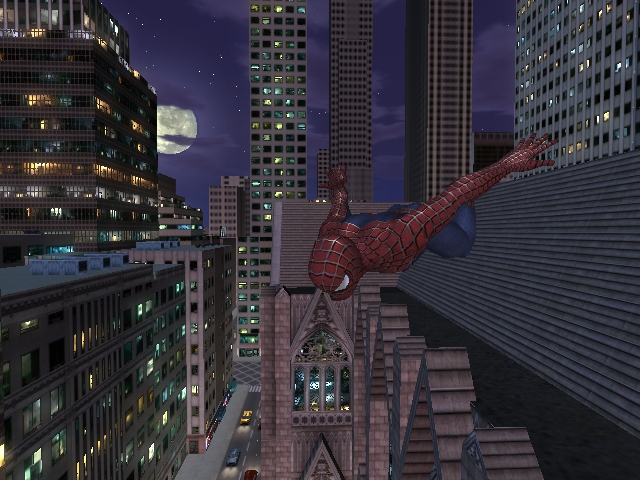 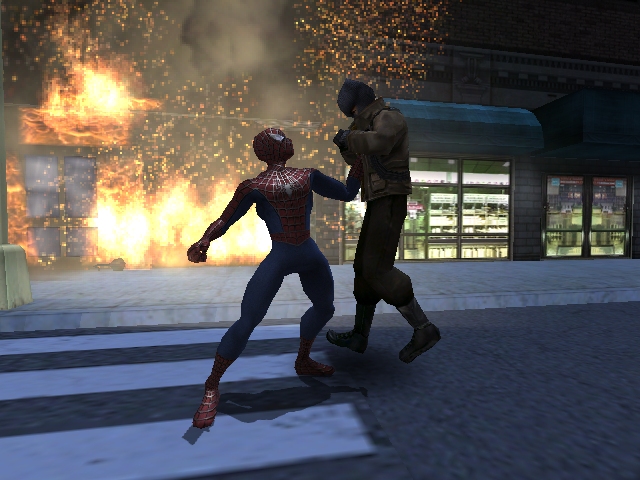
Visually, the game is an impressive sight at first look. Spider-Man looks impressive, as does the absolutely huge city he calls home. There are always civilians walking the city streets, cars driving around, and lights flashing to make the city an active one. The game switches from day to night, too, although it's not real-time, and the time of day has little to no effect on how the game progresses. On the other hand, pop-up is everywhere as you swing around the city. Entire sections of buildings just suddenly appear at times as you swing around, and although it doesn't happen near enough to Spider-Man to complicate gameplay, it is distracting to look at. Also, NPC's tend to be poorly rendered, often looking blocky in design, and characters' mouths don't move unless an FMV is playing.
Other graphical problems that seemingly belong in a previous generation's game include quickly disappearing defeated enemies, although not until the camera temporarily does not include them on screen. Also, there are camera glitches, especially when wall-crawling, and other glitches that will serve to annoy you, like random freeze-ups that will certainly impede your progress. A word of caution: save often. Overall, the game doesn't look like this a game from this generation, but in a way you also have to appreciate the sacrifices that were made to improve the gameplay and also get the game out in a timely manner to coincide with the movie.
One last graphical implementation that needs to be mentioned is the map. The small map utilized in the corner of the screen as you play is excellent, accurately displaying both the direction you need to travel to reach a target and how high off the ground it is. However, the larger map provided on the pause screen is not as good as it could have been. It has various zoom levels, and at the largest zoom, only about a third of the island can be seen. You can't move the map to any point where the icon representing Spider-Man's current location is not visible, which means that if you're looking for a certain landmark, it could cause trouble. Even at the smallest zoom level, the entire island is not visible, and by then, the landmarks are so tiny that they can only be identified by color, if you remember the colors that represent them. Good luck finding unmarked sights, like the Empire State Building or the Statue of Liberty if you aren't in just the right place.
The audio in Spider-Man 2 goes from bad to good to better to worse, and it all depends on which aspect you're listening for. The voice acting, as I mentioned, is both good and terrible depending on who is talking and about what. The music is great, but isn't always playing, and just jumps in at random times for no particular reason. To its' credit, a lot of the music sounds like it was ripped straight out of the movie. And the sound effects, sadly, are barely passing. There is no better word to describe them than "generic", because you basically only hear the sound of web lines shooting, Spider-Man throwing fists, and bad guys getting smacked. Definitely nothing to write home about.
Furthermore, some sound effects seem to be just plain missing – such as Spider-Man falling onto a car or landing on the moving blades of a helicopter (although I can't say for certain I'd want to hear that particular sound effect.) Even a few of Bruce Campbell's lines are missing from the game, when you activate the flashing help beacons that cue his assistance. The greatest problem with the audio is the repetitive nature of the sound clips. Since there are but a few lines of dialog recorded for certain events (like greeting ordinary citizens), repeating these scenarios will result in the same clip playing over a lot. It's hardly preventable, but it will get annoying, coupled with the fact that you are in a sense forced to repeat these scenarios. On the plus side, the 14 random crimes that can appear can be relayed to you by a number of different people, and although their lines are similar, they're not exactly the same, and so learning about random crimes doesn't get as boring as everything else.
Now, as for the replay value, that's really up to each individual player, since you're forced to repeat so much of the game while you're still working your way towards completing the story. And that only doubles (or perhaps triples) once the story is finished and you try to complete everything. But just because being Spider-Man while utilizing the new physics system is so much fun, it makes replay not only possible but probable. And should you get bored of replaying the same old random crimes, restarting the story will feel like a breath of fresh air in comparison. Overall, it has to be said that this game, despite its' shortcomings, has much greater potential for replay than most Spider-Man or other superhero titles, so it can't be faulted much.
Read This
While it should be evident to you by now that the game suffers from a repetitive nature, it also allows incredible freedom in letting you choose where to go and when to do it. Because of that, it's been compared to True Crime and/or Grand Theft Auto, and for good reason. Even with it's problems, the game is just simply fun to play, even if it is only a quick diversion, with the story mode lasting about 8-10 hours. Perhaps, though, all you really need to know is this: despite the shortcomings, this is hands down the best Spider-Man game ever.
- Jim Patzer
|
Information | |
Game: Spider-Man 2 |
Publisher: Activision | |
Developer: Treyarch |
Genre: Action | |
Release Date: June 28, 2004 |
Players: One |
|
Final Scores (Ratings Guide) | |
Graphics:
The size of the city is impressive, but lots of individual details are lacking, and obscene amounts of pop-up are present. | 7.5 |
Sound:
Impressive music (when it's present), lacking sound effects, and voice work ranging from good to horrible. And on top of that, it's repetitive. | 7.0 |
Gameplay:
Even though parts of it get tiresome, the incredible physics and free-roam system will keep you interested. | 9.0 |
Replay Value:
While certain missions get to be a chore, the wide variety of tasks to perform is a real plus. | 8.0 |
|
Overall Score: | 8.1 |
Rent This Game For FREE at GameFly.com |

 Main


