| Tales of Symphonia Review
Tales of Phantasia, Tales of Destiny, Tales of Eternia... If those names don't sound familiar to you, then you're far from alone. Namco's Tales series, while incredibly popular in Japan, has never made much of an impact in America. However, with the release of Tales of Symphonia exclusively on the GameCube (at least for now), hopefully this lesser known series will gain the following it deserves. Read on to find out why.
Game Features - Unique battle system, no more waiting for turns.
- Great storyline with many plot twists that spans 2 disks.
- Multiplayer Co-op with up to 4 players
- Multiple difficulties and a "new game " setting.
- Over 80 hours of gameplay
- Many sidequests that are worth the time.
- Optional Skits that benefit the story and characters
Tales of Symphonia looks like a standard Japanese RPG from the start; you have a group of characters who team up together all in the hope of saving the world. There's the typical RPG fare -- towns and Dungeons are on an overworld map and your party is usually journeying from Point A to Point B, gaining experience and many story events along the way. However, Tales differentiates itself from its standard RPG brethren by a fast and furious battle system and many unique touches such as Titles and cooking, which is why it is far more than a "typical RPG".
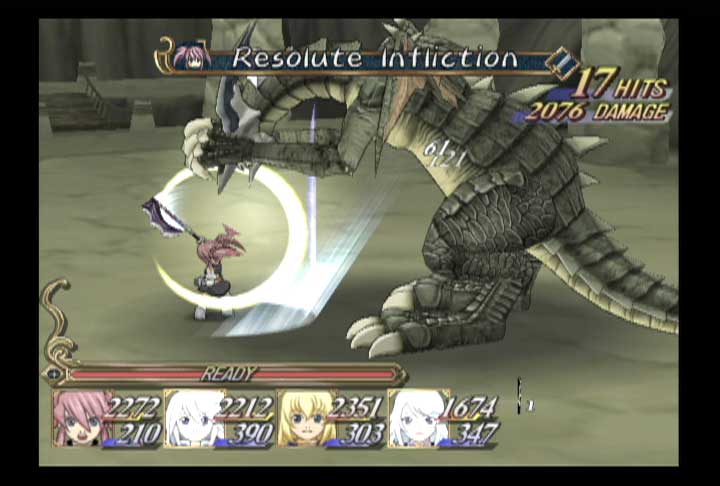
Tales of Symphonia(ToS) starts out with a generic storyline that has been told hundreds of times before. The world seems to be in rather poor shape, there are a group of people called the "Desians" that seem to have very little to do other than just make sure that life is miserable for all humans. Mana, the life essence of everything, happens to be slowly dissapearing from the land and causing all sorts of bad things to appear. Of course, your good friend Colette is "The Chosen," and her job is to go out on a journey in order to restore the Mana Tree and save the world. Of course, the Main character, Loyd, happens to be skilled in the art of swordsmanship, and decides to accompany her. A few other local villagers think that saving the world will be fun, and the journey begins with a ragtag group of adventurers. It all seems very similar, as the "mysterious mercenary" decides to join your party, and the journey ends up involving going to multiple temples and towns on the path to salvation. Luckily, the later half of the game is filled with plot twist after plot twist, and very little is actually what it originally seems.
The characters are the main focus point of this story, and they offer a very diverse amount of professions and personalities. The majority of them are somewhat cliche personality wise, but the inclusion of "skits" help flesh out every individual. Skits are unique to the Tales series of games. Activated by hitting "Z" whenever the icon in the corner of the screen pops up, skits contain small conversations from party members, sometimes about the latest plot development, angst that comes with saving the world, or perhaps something as important as the size of another character's breasts. Skits add some comic relief to what would otherwise be a rather morbid game. They also greatly help with immersion into the title and some useful character depth. Annoyingly, skits aren't voice acted in the US version of the game, while they did have voice acting in the Japanese version. Because of this poor decision, during a skit, it might be hard to follow who is talking, as the only indicator is what character's mouth is flapping at the time.
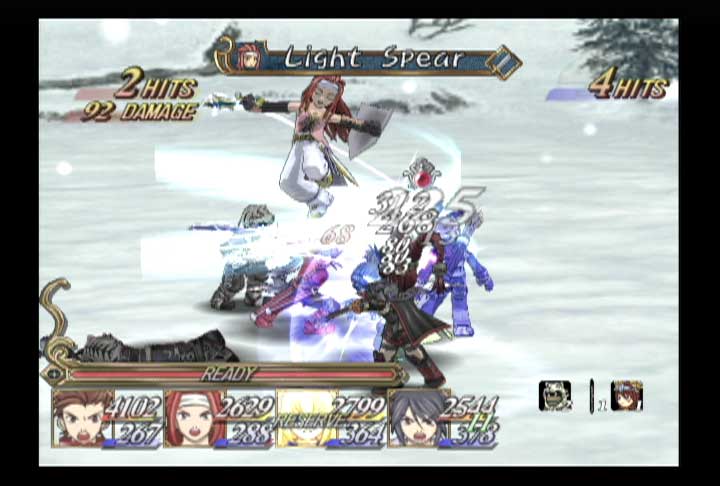
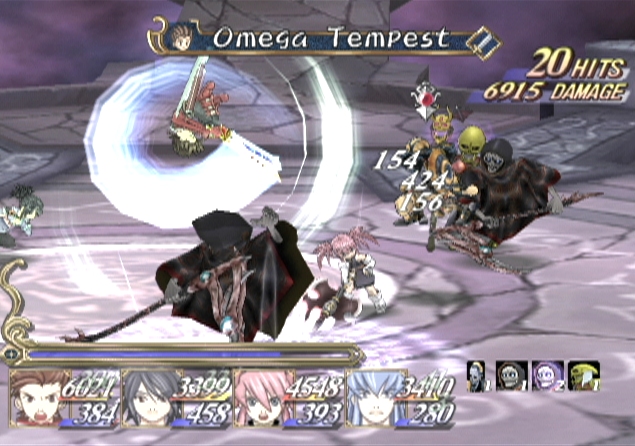
From the very first fight of the game, it is made obvious that Tales of Symphonia has a battle system unlike any other RPG. Namco uses the term "ML-LMBS (Multi-Line Linear Motion Battle System)" to describe it; of course, it can simply just be called "Fun." You control a character of your choice (the person leading the party - it will most likely be Loyd) and after, you'll assign some of your "techs" (Stuff like Magic, special sword techniques, and other assorted character specific moves) to your easily accessible B button. It's all arranged very similarly to a simplified version of Soul Calibur 2 or Super Smash Brothers, in which every combination of B direction is a different technique, and every combination of A direction is a different type of basic attack. Most battles are over in a matter of seconds, enough time for you to attack an enemy, pull off a combo, and let your incredibly intelligent AI partners do the rest. The Party AI is deeply customizable and is very far from a slouch. You can control everything from what spells you want (or don't want) your party members to use, to the distance they stay from the enemy. What enemy they are most likely to attack, which party member they should cover if in danger and how much of their total TP (MP) they should be using in a normal fight are also customizable, and you can also personally tell them exactly what to do if you think necessary.
There is also a multiplayer option, where a human can control any of the other characters in the part; however, Namco didn't seem to want to include a multiplayer friendly camera, and even with the "zoom" option turned off, it's very easy for the second (or third, or forth) player to get moved out of the screen and lost in the heat of battle.
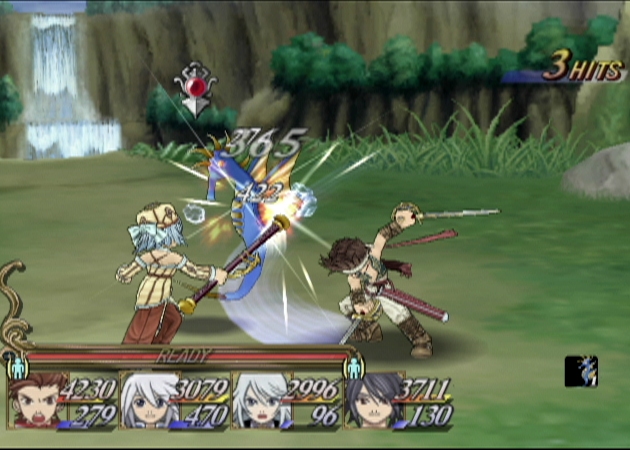
Boss Fights are a major part of the game, and for a large portion of the game are a huge challenge. Making sure you use every little bit of tactics and strategy you have learned to survive. Boss Fights can last upwards of a few minutes, which feels like an eternity with the ML-LMBS battle system. The difficulty always seem to be right on that line between possible and impossible, and beating them rewards the player with a gigantic sum of experience and a large helping of self gratitude. Sadly, near the end of the game as you get more powerful, the bosses quickly lose their challenge and end up being too easy to defeat. There are a number of optional bosses and challenges that are far more difficult and entertaining than any of the required boss battles. It's a shame a few of them are so well hidden that the majority will never find them without the aid of a guide.
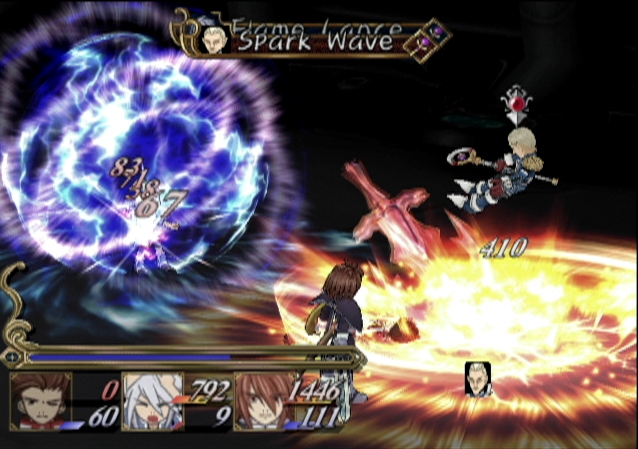
Tales of Symphonia looks amazing; there is no other way to express it. Namco decided to go with Cel-Shading for this title, and they put some massive effort behind making sure everything fits together to create a believable world. Towns and dungeons are filled with unique and fitting architecture that is stunningly intricate. Enemies and characters are drawn and animated so well that it's hard to find any flaws with them. There are also many small painstaking touches that are taken for granted throughout the game. It is very difficult to find NPC's that share the same polygon model, unless there is reason for them to share the model. (All desians wear the same armor, for instance). And even during the extremely chaotic battles, it is rare to find any sort of slowdown, even when there are multiple spells and tech's onscreen at once. Tales of Symphonia looks incredibly similar to the anime style it borrows from, and without a doubt should be considered a work of art.
The sound isn't nearly as noticeable as the graphics, and despite the outstanding previous work of Motoi Sakuraba (Golden Sun, Star Ocean and Valkyrie Profile among others), ToS's music is rather bland and uninspired. There are a few tunes every now and then that stand out and above the rest, but the majority is the generic filler music that has a bit of a mellow touch to it. The Voice acting is simply standard fare as well; none of the voices are so horribly done that you'd want to turn them off, but overall they just feel very under-acted, especially noticeable during key points in the story. During battles, there are little sound clips that are said during certain techniques and the victory screen that get overused and annoying rather quickly; I doubt I'll ever forget "Dwarven Vow Number Seven" as long as I live. Along with the horrible decision to remove voice acting from the skits, nothing in the audio department compares to the rest of the game.
Titles are one of my favorite additions to the game, but they are so simple they can easily be overlooked. After triggering special events (reaching a certain level, storyline events, or a certain hole in the wall) a character will gain a "title." Titles are additions to the stats you gain per level, and allow you to customize your characters a bit more than the typical Japanese RPG. Some Titles are nearly impossible to get, and a few titles don't do much more than simply change the outfit your character is wearing.
Tales of Symphonia also has a few more unique traits. EX Gems, which you acquire throughout the story, give each character certain special passive attributes and can be combined in such a way to form some amazingly useful effects. Adding extra hits to your attack, making you immune to status effects, and even personal touches such as being able to flirt with women to get more items are all possible. Also hidden throughout the game is the Wonder Chef, who hides inside very out of place objects randomly placed throughout the game's cities. Whenever you find him, he gives the team a Recipe. Cooking is a useful process, which happens to be far more complicated than necessary. Every character has a unique cooking ability. Some characters are very good at certain dishes, while other characters couldn't cook a sandwich to save a life. Cooking requires many different ingredients which fall under the "food" category of items, and in order to use a recipe, you have to have all of the "required" ingredients for that recipe. Sandwiches require bread; Spaghetti requires pasta and tomatoes etc. You are able to cook once after each battle, and it generally heals the entire party a certain amount based on your cooking skill. Some recipes have other useful effects such as boosting attack for the next fight.
Read This
As the 'Cube is known for lackluster support of RPG's, Tales of Symphonia is easily the best. But don't let that fool you -- it is also one of the best RPG's this entire generation. It is far from the typical Final Fantasy clone, and makes me wish I've noticed the Tales' series of games earlier. Overall, ToS is a game that quite simply should not be missed.
- Josh Wyant
|
Information | |
Game: Tales of Symphonia |
Publisher: Namco | |
Developer: Namco Tales Studio |
Genre: RPG | |
Release Date: July 13th, 2004 |
Players: One to Four |
|
Final Scores (Ratings Guide) | |
Graphics:
Cel-Shading done right; there are many points in this game where the graphics completely amazed me. Everything from the characters to the backgrounds have a hand drawn look to them. The enemies, mainly, are of a graphical quality so high that I didn't know a Gamecube could pull them off. The only annoying issue is the blurriness that Namco decided would be a good way to show depth. | 9.5 |
Sound:
The soundtrack is done by the man behind Golden Sun's terrific music; sadly, it doesn't have nearly as much uniqueness or memorable tunes. It is far from bad, just nothing special or memorable. The Voice acting is simply mediocre the entire way through the game... and a few phrases are overused. | 8.0 |
Gameplay:
An engaging story and top notch battle engine that puts almost every other RPG to shame. There is enough gameplay to easily last at least 50 hours, and you won't want to stop the entire time. The only downside is that the game eventually ends, and it all seems to go by so quickly; there are also a few minor quirks with multiplayer and boss difficulty. | 9.3 |
Replay Value:
With a very long main story, and the large amount of sidequests, the game lasts quite a while. There are also a ton of other little things to do -- get all the recipes, titles and many other items if you're inclined to do so. Namco definitely went all out in making sure you would never run out of things to do, even putting in a really innovative New Game setting and multiple difficulty levels (the last of which is insanely hard). Branching Storyline also allows for a different story a second time through. | 9.4 |
|
Overall Score: | 9.4 |
Rent This Game For FREE at GameFly.com |

 Main