SD Gundam Force Review
And now for something completely different: Bandai’s next Gundam title for GBA is nothing like Gundam Seed: Battle Assault, the GBA fighting game that released last month. Fans of the Gundam series, though, will know that this is for the best – though both anime series have Gundams in common, no other similarities exist. In SD Gundam Force, you’ll be called upon to defend multiple dimensions from the invading Dark Axis, jumping, flying, and fighting your way through hordes of evil entities. Keep reading for the full review.
Game Features
- Control any of three members of the SDG – Captain Gundam, Zero, and Bakunetsumaru – and switch between them at almost any time
- Fight dozens upon dozens of enemies in every single level
- Play through five episodes containing over 50 stages, divided over multiple branching paths
- Features a unique leveling up system that increases your attack abilities
- Collect special bonuses to unlock mini games
- Battery-backed save system – one slot
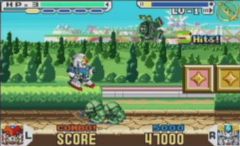 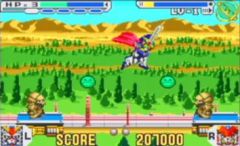
Neotopia – a paradise for humans and robots alike, is in danger. Like the dimensions Ark and Lacroa before it, the Dark Axis has come to plunder technology and disrupt the peaceful existence there. Your mission is to fight back against the seemingly endless throngs of enemies that are endangering the populace, sending them back to whence they came.
But first, you’ll need to select a character. Have no fears about choosing the wrong one, as you can “tag out” to either of the remaining two pretty much whenever you want. Beneath your life meter you’ll see five units of energy, which fill up as you defeat enemies. Each one allows you to tag one time, and they fill up so fast that as long as you aren’t reckless in switching between characters, you’ll always have several of them when you need one. Each character is vastly different from the next, so for the best results, you’ll need to learn to control them all well, and then switch between them at the appropriate times. In general, the B button attacks, the A button jumps, while L and R let you tag to the other Gundams.
First up, there’s Captain Gundam, the leader of the SDG. He usually fights with his fists, but he can also fire a laser pistol. He can dash to move through areas faster, defend himself with a shield when motionless, and unlike his counterparts, he can double jump with a second tap of the A button. Bakunetsumaru, the Blazing Samurai, is the speediest character. He carries dual swords, which he uses as his primary attack, and he can also attack while dashing, which allows him to score more hits with his blades in a shorter period of time. He can block, much like Captain Gundam, but uses his swords to do so. Though he can’t double jump, his single jump is high indeed – creating a negligible difference.
Finally, there’s Zero, the Winged Knight. By far, he is the most unique character available. Not only can he float in the air, but he can only float in the air. That is to say, he doesn’t touch ground – ever. Because of this, he is incredibly slow, but seems to have the most well-rounded attack set, although it surprisingly weak as a consequence. A single slash of the sword he carries fires an energy beam straight out, which can be charged for a bigger blast. However, charging the sword to its maximum power level (a wait time of about two seconds) opens up three new attacks. Releasing the B button by itself fires multiple sword beams at opponents. Holding up as you release B fires a small gust of wind that transforms into a tornado if it successfully makes contact with an enemy. Despite the sound of it, however, it is a very weak move. The tornado remains still, and attacks only the enemies it is practically on top of. Zero’s best move is holding down and releasing B when fully charged. This sends out a spinning vortex forward and downward from your position on the screen, which deals multiple hits, moves fast, and will even bounce off the first wall it hits and continue on at a 90 degree angle, only disappearing when it hits another wall or leaves the screen. More importantly, it allows the ever-so-slow Zero to keep a safe distance from most enemies, which you’ll be thankful for. After all, despite the fact that Zero always carries a shield, he simply cannot block.
Mastering each character is recommended, but certainly not required. With the exception of the rare tall structure that only Zero can fly over, any of the Gundams can complete any part of the game. Some more definitive reasons to play as one character than as the others during specific sections would have made a great addition. As it is, however, the game becomes very repetitive. Zero, with four different attacks, has the greatest arsenal, and since only his Down B maneuver is truly effective, you won’t use the others much, except against faster enemies, which are difficult to hit when using it. Because of this, no matter which Gundam you use, you will end up relying on the same attack again and again – as you encounter and defeat the same types of enemies again and again.
The enemies are all very similar in design, and you’ll encounter Zako Soldiers most of the time. Some of them attack bare handed, others fire guns, while others toss bombs. Some of them have thrusters, enabling flight, and these types have missile launchers, which are particularly devastating. And sometimes (rather frequently, in fact) you will be forced to stop forward progression while you fight a large group of enemies. These group battles get old in a hurry. But the lower ranks of the Dark Axis’ army are not the only repetitive battles you’ll face – even the bosses themselves must usually be fought twice. Thankfully, they at least tend to learn a new trick or two in time for the second battle – but it does little to create excitement.
The good part of it is, if (and I do mean if) you can look past the repetitive nature of the attacks and the enemies, what’s left is actually pretty fun. Part of that fun is the wonderfully animated graphics, which I’ll get back to in a just a little bit. The other main part of it is the sense of exploration. Whenever you defeat an enemy, it flies around the screen, bouncing off the edges in comical fashion. During this act, the enemy will destroy the large diamond blocks that are in your path. The yellow diamond blocks are meaningless, there only to distract you. However, the red diamond blocks are special, because they hide various power-ups which you will be most appreciative of, since most successful enemy attacks take out large chunks of your health bar. From health increases to 1-ups to invincibility to automatic level-ups, they are crucial to grab, and it is almost a game within a game to try and predict the angle a defeated enemy will bounce in, so that the red diamond blocks are crushed early and easily. You’ll also find special bonuses, which unlock mini-games for each ten you collect. The mini-games, however, are short and boring – not much worth playing for. Luckily, collecting items is always beneficial. If you can’t make use of the item you just collected, you’ll earn 100,000 points instead. Points are readily available everywhere in the game – scores in the hundred million range are not unheard of.
The most interesting element of the game is the level up system. For each enemy you defeat, you gain a small amount of experience. Earn enough of it, and you’ll level up. Each time you do, your attack power becomes slightly increased. Either the strength of your attack increases, or the attack range and breadth increase. However, it is a small increase, and it will take you several attempts at leveling up before you notice any real difference. Even more interesting is the penalty for dying – not only do you lose a standard life, but your experience meter begins to drain, fast. You’ll remain “dead” until you fill a new meter that appears by tapping buttons as quickly as possible. Only when you fill the meter does your character re-appear and your experience meter stop draining. And if you are forced to use a continue, the ultimate price must be paid – all of your experience is drained, and you must begin again from level 1.
This game is nothing if not long, though – which hurts a little, because of the increasingly repetitive battle system. The stage structure means that you can’t experience everything that the game has to offer in just one try. To see it all, you’ll have to play at least three, maybe four times (assuming that you have a great memory or keep records of where you’ve been before.) Finally, it should be noted that the final boss (Commander Sazabi) is quite an impressive entity. He’s the type that has such incredible attacks that it strikes terror in your heart. No doubt that it will take many lost lives, if not continues, before you defeat it. Every action game should have a final boss so fearsome – strangely, this is one of the few that delivers. However, like all bosses in this game, he has several reliable patterns, and once you learn them, you’ll walk all over him.
Two small glitches are apparent in the game – in one area, one of the group battles seems to hide an enemy just off screen. He doesn’t attack, so you are lead to believe the battle is finished – yet you can’t move on. This happened both times I played that particular level. The other occurs when facing a boss. Most bosses have a special attack that stops all action while an extreme close-up of their face overlays the screen. If you have an energy beam on screen when the extreme close-up happens, your attack will disappear completely. Neither halts the game for long, but both are mildly annoying.
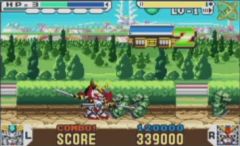 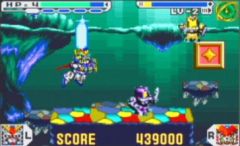
As noted before, the graphics in this game are quite stunning. Sporting a look remarkably similar to the anime, the backgrounds are lush and beautiful, not to mention incredibly varied. The characters, too, are well detailed, even making use of the GBA’s sprite scaling abilities during certain cinematic scenes. Even the enemies get their moments of glory, when hosting “Zako Zako Hour”, a sequence borrowed from the anime where they try to explain what happened in the last episode – though the player can barely understand them. Meanwhile, hurting enemies enough without killing them will cause them to run away in fright with a very panicked expression. The bright, vibrant colors used make the game playable even on a standard GBA, which seems to be unusual these days. Were it not for the aforementioned weapon glitch, it would be hard to justify not giving this game a perfect ten in graphics.
In amazing contrast, the audio featured here shares an unmistakable quality with much of the rest of the game – it’s all too repetitive. For the background music, the choice of instruments makes the fanfare-like themes in the game rich, resonant and simply fun to listen to. But they don’t last long, and then you get to hear it over again. The various sound effects are plentiful, but unless you’re straining for it, you’ll hardly hear them – not because they are too soft, but because they are masked by the incessant whining of the enemies. Since there are so many of them, it seems like you’re killing one every other second – and when that happens, they scream. And trust me, the screams they emit are not pleasant, in fact, they are downright annoying. Even with a good range of voice clips, it gets old – fast.
Traditionally, this is the point when I’d discuss replay value, but it seems hardly necessary by now. Though the game is so repetitive in nature, the branching paths and the special bonuses give it a little push in the right direction. In all honesty, I played through the game twice, and can’t imagine wanting to try for three. However, you’ll probably get a good four to eight hours out of it per run, which is pretty solid for an action platformer, especially on GBA.
Read This
If you haven’t grasped it by now, recognize that the game is very repetitive (much like the tone of this review.) However, anyone who enjoys old school button mashers will quickly adapt to this game and enjoy it. Because the graphics look as nice as they do, fans of the series will likely enjoy this in any capacity. Other players are advised to look elsewhere, as the game will end up more annoying than fun to them. If nothing else, the game does what it does better than Battle Assault did.
- Jim Patzer
|
Information | |
Game: SD Gundam Force |
Publisher: Bandai | |
Developer: Bandai |
Genre: Action | |
Release Date: October 10, 2004 |
Players: One |
|
Final Scores (Ratings Guide) | |
Graphics:
In a word, amazing. The animated look and high level of character detail mirrors that of the anime. Clearly a top-notch effort. | 9.5 |
Sound:
The enemies’ screams will be ringing in your ears whenever you finish playing. Funny at first – they just get on your nerves by the end. | 5.5 |
Gameplay:
It’s fun to have three characters at your command, yet no matter what, there is no escaping the tedium of the battle system. Yawn. | 7.0 |
Replay Value:
The level branching helps, but the repetitiveness hurts – a lot. It’s too bad, really, since most other aspects are good. | 6.0 |
|
Overall Score: | 7.0 |
Rent This Game For FREE at GameFly.com |

 Main