Prince of Persia: The Sands of Time GBA Review
Prince of Persia was a blast to play on the consoles, and now the Prince has gone back to his roots to take on the Sands of Time in this Game Boy Advance game. Ubisoft does an excellent job blending elements from the console, while adding new features that were not previously available. However, compared to the console version, it feels more jumbled, quickly packaged and not given the same treatment as its counterparts.
Game Features - New abilities not in console version
- Freeze, rewind, and slow gameplay
- GameCube connectivity
- Two playable characters (only for a short period)
The story begins when the Prince and his father travel to India to give the Sultan a gift. That gift is a large hourglass filled with magical, glowing sand. The Prince has the key to open it, known as the Dagger of Time. What the Prince does not know is that the sand within is dangerous and very powerful. He unleashes it, everything around him turns into sand and creatures form to be his father’s army. It was all a trick. Now the Prince must stop his father with the help of an Indian princess, Farah, and do whatever he can to “rewind” back and stop his treacherous father.

The Prince meets a new type of enemy in the series - a tail-swinging lizard.
The controls in the game are very responsive and are very tight. The "A" button is used to jump, twice for double jump, and "B" is used for your sword. Later on in the game, you will have the abilities to absorb projectiles with the sword using "R" and have the ability to charge your sword for greater damage by holding "B". "L" is used to utilize your Dagger of Time, which can rewind time in case you made a mistake. During the adventure, you will obtain two rings that can alter your powers. One ring gives the ability to freeze time temporarily, and the other slows down everything temporarily. The controls are slightly changed as more abilities are learned through scrolls. Most abilities, such as the double jump, rings, absorption and charge sword, are learned throughout the adventure a lá Metroid and give you access to the next part of the level.
There are many ingenious gameplay concepts featured in the handheld version. In the console version, a computer controlled Farah and made you feel that you have to rely on her to help you open certain doors and switch traps. In this version, they allow you to control Farah to help the Prince along his journey. The only drawback is that they do not use her to her full extent; she is only available in a portion of the game.
In the console version, the platforming and fighting were two distinctive parts. In the handheld version, it is mainly all about platforming. There are virtually no new moves learned for combat, and the basic strategy used when engaging in a battle is running up to the enemy and beating them down until they fall, and taking their sand. The boss encounters are exceptionally poor as well, as you must fight the same boss four times (with harder difficulty) until you get to the final boss.

The Prince taking on the fourth boss, for the fourth time.
Another drawback is the difficulty. This could have easily been remedied with more save rooms located throughout the palace. If there were more save rooms, it would have given you more opportunities to attempt to clear the level, since, when you die, you must start back from where you last saved.
And that brings me to my next point. Many of you are probably thinking that there are not that many save rooms because of the Dagger of Time. While it may grant you the power to rewind, this feature is executed poorly compared to the console version. The majority of the time, when you begin to rewind, it is too late as the meter runs out. The only purpose in using the rewind feature is to grab a medal when jumping (in order to obtain a medal, you must jump for it and rewind in order to grab it). Not only that, but the rewind feature cannot be used during any boss battles. This is probably due to restraints in hardware as it can’t process that much at one time. It was clever that they added rings to alter the Dagger’s properties, but these new ideas feel more forced because they are not balanced throughout the game and are used only once, maybe twice in a room.
Graphically speaking, the fluidity of the Prince and characters are amazing. Not only the animations, but the transition from one animation to another are also breathtaking for a handheld. From rolling, to flipping mid-air, to spinning, the many moves at your disposal are easily done and are done to perfection. Also, the depth and shading of the Prince was quite noticeable. When the Prince hung from a balcony, his arch made it feel like he was sticking out, instead of being a flat character. Another example of this depth and shading is that whenever the prince walked across an edge, he would always put his sword behind his head, giving the feeling that there is room around his body and he is free to move in almost every direction. The Prince is not the only one who has such great looks. Many of the enemies and bosses have bulging muscles that protrude out, giving the characters depth visually.
The backgrounds are another story, however. The entire game is played in the palace with different colors used for the walls. They do not offer grand locations similar to the console version, like ice caverns or a jungle setting -- just the simple tan palace designs. Another nitpick is that the background illustrations do not match the character’s and they feel very out of place. The backgrounds are much more softly drawn, while the characters are distinctly drawn with a thicker line.
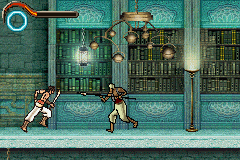
An enemy with a spear charging at the Prince.
Most of the tunes in the game are simple, and they aren’t very catchy; you can expect the simple Middle Eastern style of music with drums. However, the music gets the job done. Whenever you get near an enemy, the music changes into a harder drum beat giving you a sense of urgency and helps keep you in a more alerted state. The enemies’ screams and roars are predictable and not noteworthy.
In this game, there are 75 enemies to defeat, and each one will increase your stats. Also, there are medal fragments (eight in all) which increase your stats. This "collect-a-thon" of medals and enemies is cumbersome, but allows you to bulk up your character before a boss battle. If you missed anything, in your inventory there is a map which helps you locate all items. These tedious but challenging quests help you by boosting your power, and ultimately finishing the game with ease. Connecting the game to the GameCube also offers extra levels for your enjoyment.
Read This
In the end, this game is almost as fun as its counterparts, and is a great game if you enjoy adventure and jumping around like a monkey. But overall, it wasn’t given as much recognition and therefore probably wouldn’t warrant a purchase unless you are a die-hard Prince of Persia fan, or just feel like a playing an adventure game.
- Kumar Arora
|
Information | |
Game: Prince of Persia: The Sands of Time |
Publisher: Ubisoft | |
Developer: Ubisoft Montreal |
Genre: Adventure | |
Release Date: November 14 2003 |
Players: One |
|
Final Scores (Ratings Guide) | |
Graphics:
The characters had excellent animations, mainly the Prince. The character design was far better than the console version, offering more types of enemies. The backgrounds could have been a little less bland though. | 8.0 |
Sound:
What you would expect in a Middle Eastern world. The tunes aren't very memorable, and you probably won't be humming them whenever you aren't playing. | 5.0 |
Gameplay:
Gameplay is what made the console version of the Prince so great. The same principles and ideas were in here, but they just didn't work out. They added new features, and did not focus on the ones that were most important. | 7.0 |
Replay Value:
When you are done with the game, you can collect the medals and 75 enemies that you missed to increase your stats. There are also extra levels by connecting to GameCube. | 5.0 |
|
Overall Score: | 7.0 |
Rent This Game For FREE at GameFly.com |

 Main