Shining Soul II Review
Last year, Atlus released SEGA's Action RPG Shining Soul in the U.S. for the Game Boy Advance to lackluster reviews. Already six months later, the company has released a sequel to the game -- Shining Soul II. Can the newest game in the series, comparable to Diablo II or Baldur's Gate: Dark Alliance, featuring eight character classes and an engaging multiplayer mode, succeed where the first didn't?
Game Features: - Eight unique character classes with different styles of play
- A large amount of levels to conquer
- Multiplayer Co-op with up to 4 players
- An "Advanced" difficulty that is unlocked once you finish the game.
- Eight save slots
- Randomized item drops
Being a sequel, Shining Soul II starts out with an incredibly long back story of the game; unfortunately, it is not very interesting. The basic premise is that Light and Dark need to be balanced in the world, although according to some old geezer with a crystal ball, the power of darkness is soon going to break the balance and try to overthrow the power of light. Yet one person will rise up and fight against the power of dark. Simple fantasy fare, and as you can imagine, that one warrior happens to be you.
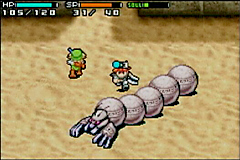 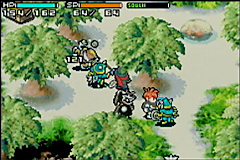
Shining Soul II (SS2) has one major town area, which has many different shops, a free inn, an incredibly large amount of hidden passages (check the walls) and a large cast of characters that will usually need something done before the end of the game. The main quest itself is rather linear; as you finish a stage, the king tells you about the next area through which you're going to have to quest. The stages are all selected on an overworld map with a pointer, which allows you to go through and revisit stages that you have already finished -- perhaps to finish a side quest or so that you can receive more experience. Generally, for every other story driven stage, there is also a hidden side-quest stage that you need to unlock. These side quest stages are a nice diversion from the main story, and usually give you a decent reward in both experience and an item of some sort.
There are a total of eight character classes in the game, and a hidden one is unlocked after you finish the main quest -- Warrior, Archer, Sorceress, Dragonute, Priest, Dark Mage, Brawler and Ninja. Each class has a different approach to the game. While the Dragonute is a very slow tank, the Ninja attacks swiftly and tries to confuse its opponents. The Dark Mage focuses more on using status effects to cripple its foes, while the Sorceress uses damaging elemental spells. Every level in the game gives you four stat points and one skill point, and allows you to place them however you desire. Every class has 8 skills. All 8 skills are available at the start, so you have the choice to raise whichever skills you want. This allows the chance to craft your character into something completely different than another character of the same class. Every skill in the game has 7 levels, and in order to raise it a level you need to put an equal amount of skill points into it. So a level one skill requires one point, but a level 5 skill requires 5 points to raise it another level, By the time you try to achieve the 7th level of a skill, you have actually put a total of 28 skill points into it. Luckily, there happens to be a max level of 200 in this game, even if you are only around level 50 before you finish normal difficulty, the game isn't over yet. Advance difficulty, which starts off right after you complete normal, has the same maps and story as the original game (without the annoying opening cinema), but with much harder enemies, revamped boss fights and better items. The whole game is a bit on the difficult side, but Advanced is incredibly hard, especially with the later levels. Advance mode is very similar to "Nightmare" mode in the Diablo series.
The game uses a simple system of item management (5x5 grid on a menu) and attacking. There are 3 (you receive more later on) empty boxes that you can equip a weapon in, and also 3 boxes for healing or throwing items. Weapons are attached to the "A" button and you cycle through them using "L" and the healing items are used with the "B" button and cycled using "R". It's simple and if you're a melee character, having a healing item with such easy access can be a life saver. The majority of the gameplay revolves around running up and hitting things with a weapon for the melee classes, or allowing your spells to charge (simply by choosing the spellbook of your choice then holding down "A") and releasing them on foes with a mage. The gameplay is, in fact, rather repetitive, but it has the same addicting quality as most other games in the genre, where you continue based more upon trying to find better items and leveling. Sometime in your journey, you will also come across "Souls" which have their own equipment slot. Souls are basically summons that destroy everything on screen. Once you have a soul equipped, you will charge it up by killing enemies (it takes quite a bit to get it full -- roughly around every 100 slaughters) and then you trigger the soul by hitting the select button.
A few of the bosses here and there are incredibly cheap, and sadly, not all character classes are balanced (Mages seem to overpower Melee). Death is also dealt with in a very casual way. If and when you die (and you will die), you are transported back into the inn in town. You lose half of the money on your body (which isn't a problem, as you should start storing money in the very useful bank) and one piece of equipment is dropped onto the ground. However, right outside of the inn is a lovely little angel who is more than willing to transport you to the exact room where you died. With such a small punishment for deaths, it is rarely a concern about trying to manage item space for potions, or being able to stay alive that long. (Whenever you die, you can just sell off items in town anyway.) For bosses, however, death isn't as kind, as every time you die you have to restart the entire boss battle, which is even worse in a multiplayer game. If you die on a boss and there's no one that can revive you during the fight, you cannot go back to the boss fight till everyone wins or loses, sometimes causing you to lose out on a ton of boss experience and the boss chest.
The game was obviously made with multiplayer in mind, which is both its highpoint and its lowpoint. If you have friends who also happen to have the game nearby, it's an incredibly fun multiplayer game as you and your friends go through the game together, trading items and supporting each other. However, because of the amount of effort geared towards multiplayer, there are a few annoyances that will become very obvious if you only play single player. For instance, while Sega did take the time to change the chest drops so that they only drop items relevant to your class (Bows if your an archer, swords if your a warrior) they didn't change the monster drops, which means that a mage could very well find a very nice heavy armor, with absolutely nothing to do with it but sell it for more gold. Also, the start button which brings up your inventory and status page doesn't actually pause the game, which means that while you're sitting there trying to equip a new item, or just seeing if you have any space left you can easily be attacked because you cannot see any enemies nearby. Luckily, they do leave your character sprite on the screen, so that if you are attacked you will be able to realize this and react quickly.
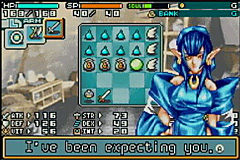 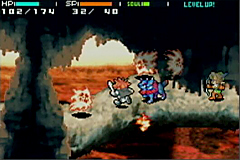
The graphics in this title are simply average, although there are a few flashy effects during the soul summons and the backgrounds are all nicely done... The character sprites have a very hand drawn look to them and animate with very few frames. There are a ton of different enemy varieties, and even more because of the abundance of pallet swaps used during the game. The sound effects aren't anything special, and seem nonexistent throughout most of the game. There is a nice variety of music, which also sadly means a large variety in the quality. A few songs are very catchy and are worth hearing, while other songs are quickly annoying. However, they both complement the gameplay and feeling of the game quite well, as it never takes itself too seriously.
Read This:
Shining Soul II is a great and addicting Game Boy Advance game for those who are a fan of the Action-RPG genre, and even for those who just want an enjoyable game. While nothing new or revolutionary, it is a steady title in a genre that's all but ignored on the GBA. If you have any friends with the title, the game is very difficult to put down as you all work in cooperation to save the world. There is an incredible amount of replay value if you're willing to tackle the advanced difficulty or try a different class through the game. However, while alone, the game does lose a bit of its steam.
- Josh Wyant
|
Information | |
Game: Shining Soul II |
Publisher: Atlus | |
Developer: Sega |
Genre: Action-RPG | |
Release Date: April 20th, 2004 |
Players: One To Four |
|
Final Scores (Ratings Guide) | |
Graphics:
The backgrounds range from mediocre to beautiful. Summon effects are dazzling. Animation on the character sprites could have been better, Pallet swaps are used too often. | 8.0 |
Sound:
A few of the stages have really catchy music. Each character has a unique pain yell, otherwise everything is generic. | 8.0 |
Gameplay:
Steady difficulty level, game remains constantly challenging. Multiplayer allows for some interesting strategies. Gets repetitive, some classes are more interesting than others. | 9.0 |
Replay Value:
Each class requires a unique style of gameplay, so every one is worth trying. Level cap of 200 if you want to try for it, multiplayer adds an entire nother dimension with item trading and co-op. You sadly can't skip or speed up the story, so you have to bear with it every single game. | 9.5 |
|
Overall Score: | 8.4 |
Rent This Game For FREE at GameFly.com |

 Main