Digimon Racing Review
The Digital World is under attack from powerful Digimon bosses, and data is being drained across the land. Have no fear, however, there is one way to stop them… win the Digimon Racing Circuit! If you haven’t played your yearly quota of racing games with bad storylines, well, why not consider this one? Keep reading for our full review.
Game Features: - 11 Digimon to control (3 hidden), each with their own special power
- 12 tracks
- 3 bosses
- Cup, Quick Race, and Time Trial Modes
- Wireless multiplayer using GBA Wireless Adapter (currently scheduled to ship 09-09-2004)
 
Okay, you know the story, so let’s get right to the action: Digimon Racing is your typical go-kart racer, starring some of the more famous Digimon out there. Selecting your racer is not as easy as picking your favorite, though: each is rated in Speed, Handling, and Acceleration, and has its own special power to use, making it necessary to play with them all to determine a true favorite. One extra feature allows you to select one of 12 different kart colors for your Digimon as well.
Appearing in this game are Agumon, Gabumon, Palamon, Patamon, Tentomon, Biyomon, Salamon, and Gomamon, along with three not-so-secret racers that you can unlock. Since they race along with you before you unlock them, their identities are no secret: they are Guilmon, Veemon, and Agunimon. These last three are the best racers in the game, although only slightly, so it’s at least something to work towards.
In Cup Mode, you’ll race in a standard tournament-style set of 4 races against 5 other Digimon. Earn the greatest amount of points by the end of the final race, and you’ll win a gold medal and go on to fight the cup boss. The cup boss is a fairly unique element, and each boss will require a slightly different strategy to beat, although I consider the third and final boss the easiest of them all. The point structure makes the outcome of a game very predictable, however. The spread is 27-18-9-3-1-0, and since the best racer doesn’t always place 2nd (or 1st, depending on your skill level) like in the original Super Mario Kart, it often occurs where you can place dead last in the final race and still win the gold medal.
Let’s talk gameplay: "A" accelerates, "B" brakes, "R" leaps, "L" fires your weapon, and Select switches between your special weapon and regular weapon if you have both available. You can grab a boost start at the beginning if you time it right (which is not difficult at all.) On every track you’ll find some type of obstacle impeding your progress, which ranges from utterly simple to annoyingly difficult. With a bit of practice, they’re not much trouble, and up the variety level in the game. I particularly like encountering the Numemon on the Toy Town track. When hit, they leap up and hit your game screen, obstructing your viewpoint.
As you race, your primary objective will be to run over the Fractal Energy Grids that appear on the racetrack. They’re not hard to find, since they are black and white grids in a world of color. Doing so powers up your Digimon to Champion mode, which allows you to race faster – so much faster, in fact, that ignoring your fractal energy will surely cause you to lose.
Fractal energy, the most important thing for a racer to pay attention to, is measured by a meter appearing on the left side of the screen, and is split into three pieces. If you are hit by a weapon, use one of your weapons, run into dangers on or off the track, or are bumped into or landed on by an opposing player, you will lose some fractal energy. If it decreases too much, you’ll return to Rookie Mode (the default mode), and eventually Training Mode, which causes you to drive v-e-r-y s-l-o-w-l-y. At least in Training Mode, you slowly regenerate fractal energy anytime you’re in motion, making re-entering Rookie Mode easy. Your Digimon’s form changes in each form as well. For example, Agumon’s training form is Koromon, and his Champion form is Greymon.
To attack opposing racers, you can pick up weapons from item boxes scattered over the track. They include the following:
- Blue Bubble: Fires straight ahead
- Red Bubble: Fires ahead and homes in on the nearest opponent within a specific range
- Bomb: Dropped behind you as a trap
- Fractal Energy Fill: Boosts your fractal energy by one level
- Speed Boost: A very short turbo effect
- Affect All Ray Blast: Hits everyone on the playfield, stopping them temporarily and reducing their fractal energy
- Shield: Shields you from all attacks and acts as an offensive weapon when you collide with other racers
Special weapons are a particularly cool addition, since they are extremely powerful and guaranteed to you with upon collecting enough fractal energy. Even though the Affect All Ray Blast is the best weapon to have, you’ll rarely, if ever get it when you are in a high-ranking position. Deciding which power you like best is difficult. Should you use Agumon, whose simple but effective Nova Blast homes in on the nearest rival in front of you, while draining lots of fractal energy, or perhaps Salamon, who uses Cat’s Eye Hypno, which reverses left and right for the affected driver, almost always steering them off the track? Of course, there are many more choices, and your choice may also be influenced by which attack you hate getting hit with the most yourself.
Monitoring your fractal energy is arguably the most difficult task you’ll face in the game. Since the simple act of firing a weapon costs you fractal energy, you have to weigh the consequences against one another: is it worth risking returning to rookie form and a substantially slower speed if you choose to fire the weapon? The answer usually comes back as a resounding no, unless your meter is topped off or you know a fractal energy grid is coming up very soon. Even with a topped off meter, firing your special weapon followed by a regular one usually results in being powered down, which begs the question: why was a dual item holding system even included?
Meanwhile, the other challenge you’ll find in racing is that the controls are very slippery, so turning is rough, especially since there is no type of power sliding featured. You’ll end up trying to jump to make up for the lack of control, but the jumps are so outrageously high that it’s hard to keep control that way as well. It’s a major adjustment, no matter what racing game you’re used to playing. The tracks are built extra wide to compensate, though, so if you start turning early, you’ll make it, and learn to adjust to boot.
The biggest problem that the game has is the extreme shortage of tracks. There are only 12 (15 if you count the boss battles) and they are repeated throughout Cup Mode in different orders. After the first three cup races, you’ll only have to race three tracks per cup, shortening game length but reducing repetition and increasing difficulty, since you have to perform better outright to ensure a victory.
Bosses are definitely one of the more interesting additions to the game, even if they are a little plain in design. Each one involves you driving around an arena with obstacles and various dangers, avoiding attacks, and returning attacks. Unfortunately, the boredom sets in a little because you can’t use your special attack here, and the only regular attack you can get is the Red Bubble. Still, it is a feature not often used in kart racers, and a welcome addition by default.
Meanwhile, the other two modes probably won’t see much overall play time. Quick Race lets you play one race with competition, while Time Trial lets you race alone against the clock. I beat each respective track on both in a single try, and never felt encouraged to go back. Come to think of it, I only had to repeat one of those cups due to receiving a silver medal my first time. Mostly, the game progressed much too quickly.
Of course, the difficulty level can likely be explained away since the game’s target must be young fans of the Digimon cartoon, and for them, the game will be challenging enough. However, the later stages will prove to be difficult for them, as the AI improves and seemingly gets more of the good weapons, making first place victories much tougher to achieve. Considering the slippery controls as well, and the game has more than enough challenge for young gamers, but most will find it on the easy side.
 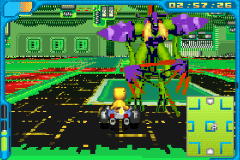
Moving on to the graphics, you’ll see that what’s offered is pretty much standard fare. The characters are the best looking part of the game, with a smooth rendered look. Everything else in the game is bland in appearance, from the plain look of the tracks to grainy looking items and item boxes. The menus are sleek in design, and gamers can choose from two different HUD (heads-up display) styles. One major problem with the game is that it runs awfully sluggish on the Game Boy Player for some reason. The frame rate is great in your hands, but on the TV screen it’s rather annoying. One other issue is that you’ll encounter objects on a few tracks that appear to be jumpable, but are actually protected by invisible barriers that stop you dead in your tracks if you try. On the other hand, some objects that look jumpable are jumpable, and are legitimate shortcuts. As a result, trial and error followed by memorization is the only way to truly stick it to the competition.
The music featured in the game is full and crisp sounding, which is a plus. However, it is very quiet during the actual races (by default), making it tough to hear above engine noise. I fully recommend adjusting the volume levels in the options menu, but no matter what, music is still difficult to hear in a tight crowd of racers. Sound effects are average, and nothing more than you’d expect from a standard racing game. It’s really a shame that they overpower the music so much. Voice work is also featured in the game, ranging from an announcer to the Digimon themselves, who have a small number of things to say. Overall, the sound is simply not anything special, even though it excels in a few areas.
Since I’ve already half-covered replay value, I’ll just repeat the few important details: the tracks are few, and you’ll be done with this one within a couple of days. Since the tracks repeat so quickly, even playing “new material” can feel old, while it lasts. Wireless multiplayer will surely add to replay value, once the adapter is released. That is, assuming your friend(s) also buys the game, since multiple carts are needed. Just keep in mind that the game is quick & dirty if you’re thinking about a purchase.
Read This
While Digimon Racing won’t knock anyone’s socks off, it’s fast-paced fun if you want a simple racing game and you’re already tired of Mario Kart. You will get tired of this even sooner due to its length, but fans of Digimon will find it easier to get into. Its best quality, as I’ve mentioned, is that despite being a clone of a popular game genre, does several things to try to distance itself from the pack, such as including character-specific weapons, boss battles, and the dual-item system. It’s at least worth a look if you’re an arcade racing fan.
- Jim Patzer
|
Information | |
Game: Digimon Racing |
Publisher: Bandai | |
Developer: Griptonite Games |
Genre: Racing | |
Release Date: August 2004 |
Players: One to Four |
|
Final Scores (Ratings Guide) | |
Graphics:
Character detail is good, everything else less so. Looks decent anywhere but on a Game Boy Player. | 7.0 |
Sound:
The music is drowned out by the engine noise half of the time, and it’s not pleasant. Actually, the music alone is good, it’s just too bad for the rest. | 6.5 |
Gameplay:
Simple fun, but over too quickly. Much too quickly. | 7.0 |
Replay Value:
It’s got that pick-up-and-play style going for it, but not a whole lot else. | 5.5 |
|
Overall Score: | 6.5 |
Rent This Game For FREE at GameFly.com |

 Main