Fire Emblem Review
February 14th, 2004 - Written by Kathryn Bell, Staff Writer for Nintendo Insider
 Just a few short years ago, GBA gamers were blessed with a game by the name of Advance Wars that has flooded Japan systems for years. Advance Wars took the United States by storm, after a short delay of release because of 9/11. However, two years have passed, and not only have we been witness to an Advance Wars sequel (or expansion, I should say), but an amazing title straight from the Japanese hit series, Fire Emblem! Although Fire Emblem for GBA has been released for over a year now in Japan (they already have the sequel), we have finally been blessed with Fire Emblem, and for any strategy gamer, it has been well worth the wait!
Game Features - Test your skills as a military strategist, as you guide your forces in battles with wizards and dragons.
- Dominate the field war with dozens of soldiers, weapons and magic spells that will be at your command.
- Take control of an army of soldiers, but use them wisely. Each of your soldiers possesses unique skills but, if they fall in battle, then they're lost forever!
- Strike from above with your Pegasus Knights or guide your armored footman in close combat.
- Clear a specific objective in each level to proceed to the next. Special events open up branches in the storyline and offer more difficult side quests.
- Challenge friends to see who has the stronger band of soldiers in the multi-player mode.
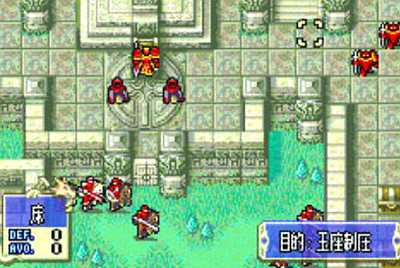 
Fire Emblem follows the medieval story of a young strategist (that’s you) who finds himself in the middle of a battle of feuding families. Shortly after the beginning of the game, you are introduced to Lyn, a female descendant and rightful heir to the throne. However, her evil Step-Uncle, in all his “bad guy deception,” has taken over the countryside, and it is up to you and your little rag-tag group of rough-ians to aid Lyn in the quest for her birthright!
From the very first screen of the game, Fire Emblem feels very Advance Wars-esque. The battle maps and interface layouts are exactly the same, only done in a medieval setting. The maps are grid based, and the game is turn based just like its predecessor. Players navigate their units across the map to conquer certain points, defeat key enemies, or defend their base. Any veteran AW player will feel right at home with the flawless presentation of Fire Emblem.
The fighting engine for Fire Emblem is very similar to previous turn-based titles as well. However, there are little changes to the game that seasoned AW players will be happy, and interested, to see. For example, rather than having units that are strong and weak against each other, such as tanks and infantry, Fire Emblem uses a “weapon triangle” and “magic triangle.” Attacker’s weapons are pitted against each other, and that distinguishes who has the advantage. A sword is strong against the axe, an axe is strong against the lance, and the lance is strong against the sword! The magic triangle is similar to the weapon triangle, but consists of a light, dark, and neutral magic type. Once a battle begins, the attacker goes first, deals their damage, and then the defender is allowed an attack (as long as they are within range…). After the defender counters the attack, the attacker has a chance of hitting again. This depends mostly on the specific weapon the attacker is using, or on the stats that they have (for example, Lyn attacks x2 every time, making her a very valuable asset). If players play their cards right, they can attack, dodge the counter-attack, and attack a second time! A nice little touch to the tactics world. When all is said and done, the difference in fighting engines is enough to set apart Fire Emblem from AW, and is definitely an improvement on the older attacking as well.
Another amazing part of Fire Emblem is the amount of depth in the game. Every character has specific weapons that will level up or wear out as the game goes on. Also, specific items will change the classes of some characters. Every character in the game is also a main character, and you will find no duplicates of any of them. If a character dies in battle, they are dead for good, making every second of battle a nail-biter. To make matters worse (or more exciting…), the game auto saves after every move, making every action feel very permanent. If you don’t like the results of a mission (such as the loss of a key character) you can always restart, but the feeling of commitment is made very strong with the auto-save function. The feel of Fire Emblem is very engaging, since you gain an emotional attachment to every character you use, as each character levels up and gets stronger as the game progresses. Your team isn’t just a group of expendable infantry and recon units, they’re a family.
From the gameplay aspect alone, Fire Emblem has set itself apart from the Advance Wars experience. However, there are many other things that also contribute to Fire Emblem’s unique presentation that set it apart from being just another face-lift. For one thing, Fire Emblem does not stress multiplayer in the way AW did. In fact, apart from the “duel” mode for 2 players, and the story mode for one-player, there is nothing to be found. No create a map (just a shame), no war-rooms, and no dozen’s of unlock able multiplayer maps! Fire Emblem is more of an “Advance Wars RPG” than it is a massive video-board game. However, while Fire Emblem is weak on diversification, it focuses on a very strong 1-player campaign. Maps are littered with villages to visit, shops to explore, and castles to siege. All upgrading, shopping, and story between the villages, happens in-game during the heat of battle: a very intriguing way to do a game. Go ahead and send some characters to the shop, but just remember to have that bridge guarded: The enemy isn’t far!
Graphics:
The graphical presentation is basically a medieval touch on the AW style. However, the in-game work isn’t as polished or bright as Advance Wars is. Characters look a little rough filling in the on-screen grids, and the battle sequences just aren’t as vivid as the original GBA masterpiece. However, the story portraits are still there when characters are talking to each other, and the characters do look very nice when engaged in combat, filling the screen and striking epic animations. However, every negative aspect should be taken in context, since I’m comparing it to one of the most graphically amazing pieces of work the GBA has seen thus far. Fire Emblem gets the job done very well, and only Advance Wars extremists will even realize what I’m talking about with the graphical presentation. The effects look great, and battle characters look great, and the overall presentation is right on pace with past titles.
 
Sound:
Another area that Fire Emblem seems to nail is the musical aspect to the game. For players who enjoy an involving score, and crisp, clear sound presentation, Fire Emblem will not disappoint. Every spell, slash, clang, and beat of this game is dead on, and there is absolutely nothing bad to say about Fire Emblem’s audio. Crank up the volume, or pop this one into the GBA-TV: You will want to really feel this engaging masterpiece.
Replay Value:
Adding to what was previously stated above, Fire Emblem doesn’t have nearly as much replay value as Advance Wars, with the endless amount of maps, missions, and multiplayer mayhem. There is no “Pass the GBA” Vs mode, no create-a-map, and no war room where players can take a break and just enjoy casual warfare. However, what Fire Emblem lacks in Vs. appeal, it makes up for in an amazing one-player adventure, featuring involving stories and battles, with the pressure of losing any character at any time for good. The game is the birth-child of Advance Wars and Final Fantasy Tactics Advance, and any game that can say that has some serious bragging rights. But be warned, strategists -- this game isn’t about multiplayer, it’s about you and your team!
Read This:
Ever since the first screen-shots of Advance Wars were released just a short time ago, I have been captivated by the board-game style of these turn based strategies. Nintendo is delivering another masterpiece with its latest installment of Fire Emblem. I am happy to report that Fire Emblem is not just another Advance Wars clone, and that each of the titles is going to give you different experiences. Fire Emblem dares to be difficult, with its harsh style of play. If a character is killed, they are gone forever, and that is a hard fact to deal with. However, this is the only game I have been able to find that really goes toe-to-toe with Advance Wars and Final Fantasy Tactics Advance. If you are looking for another amazing turn based strategy to sink your teeth into, this is definitely the game to get. This game almost didn’t see American shores, and there is a sequel out already in Japan. Let’s make sure we recognize good games when we see them, and ensure that we will see the next installment of this amazing title on good ole U.S. soil as well. Grab your battle axe and meet me at the draw-bridge: this is going to be one heck of an adventure!
- Kathryn Bell
|
Information | |
Game: Fire Emblem |
Publisher: Nintendo | |
Developer: Intelligent Systems |
Genre: Strategy RPG | |
Release Date: November 3rd, 2003 |
Players: One To Four |
|
Final Scores (Ratings Guide) | |
Graphics:
Not as pretty as Advance Wars, but definitely one of the best on the system. | 9.0 |
Sound:
Great audio presentation. The sound of Fire Emblem just adds to the overall grandness of the game! | 9.5 |
Gameplay:
We asked, and the game delivers. Not just another Advance wars upgrade. This game goes toe-to-toe with the best of em! | 10 |
Replay Value:
The only area Fire Emblem comes up less than excellence. Definitely one player focused. It does, however, have tons to accomplish for all those hardcore completists out there. | 8.0 |
|
Overall Score: | 9.4 |
Rent This Game For FREE at GameFly.com |

 Main