|
Gaming Glossary
When a non gamer enters our site for the first time, it's obvious that there will be some confusion over technical terms used casually on our site. For instance, one of the most common questions we get has to do with what bump mapping is. In order to make sure everyone is on the same page, we've included definitions of common gaming words below. If you want to know the meaning of a word that is not contained in the list below, please e-mail us. And of course, for general words, try a website such as dictionary.com.
4:3: 4:3 (also read, 4 by 3) is the standard resolution for most TV's. Most videogames, movies and televisions run in 4:3.
16:9: 16:9: (also read, 16 by 9) is wide screen mode. This resolution is slowly becoming a new standard, as it allows for wider viewing than the traditional 4:3. Only certain TV's, such as some HDTV's, support 16:9.
480p: 480p stands for the resolution of 640x480 pixels (how many lines are displayed horizontally). This is a progressive format and is only supported by HDTV's.
720p: 720p stands for resolution of 1280x720 pixels (how many lines are displayed horizontally). This is a progressive format and is only supported by HDTV's.
1080i: 1080i stands for resolution of 1920x1080 pixels (how many lines are displayed horizontally). This is also a progressive format and is only supported by HDTV's.
Anti-Aliasing: Anti-aliasing is the rendering process that gets rid of aliasing (i.e. jaggies) in games. (Jaggies are graphical lines that are jagged instead of straight; in racing games, this is often a problem because you can't always tell what's coming ahead very well). For a thorough explanation with pictures, click here.
Artificial Intelligence (AI): Artificial Intelligence is the "intelligence" level of the computer-controlled characters in a game. All characters not controlled by a human player are labeled as "AI." Certain characters within games are created to have a harder AI, and in many games there is an option to change the difficulty level of the AI, which increases the AI of computer characters. When an opponent is said to have smart AI, that character usually makes seemingly lifelike decisions, and doesn't simply carry out scripted events.
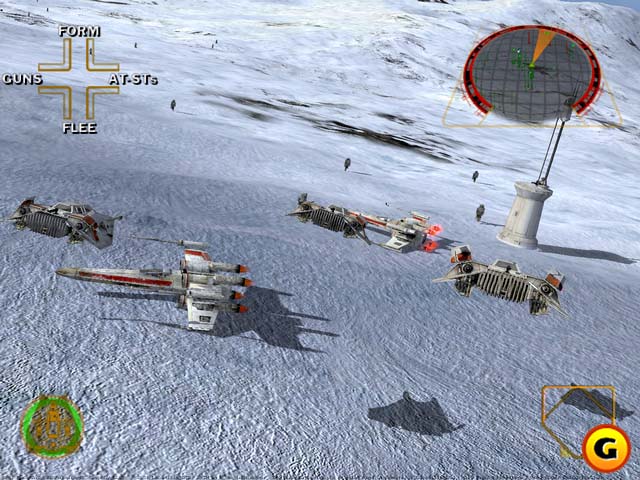
Bump-mapping: Bump-Mapping is artificial depth created through the manipulation of light on a texture map. In other words, developers, when using the bump-mapping technique, are making objects in games look bumpy without actually creating every single bump you see out of polygons (they do this with lighting). (In this example of good bump mapping, the land in Rebel Strike's Hoth level is bump-mapped).
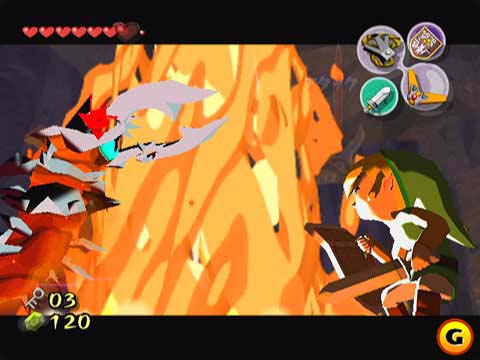
Cel-Shading: "Cel-Shading" is a way of lighting 3D models in a game. Basically, the model is rendered the same way as it would be in any other 3D game, except when it comes to drawing the surface, only one or two shades of each color are used. Instead of getting all the shades and hues of a realistic surface, you get solid colors. As a result, the object looks hand-drawn -- like a cartoon. In fact, it's called "Cel Shading" because the end result looks like the "Cells" of a cartoon." (In this example, The Legend of Zelda: The Wind Waker is cel-shaded. Zelda had excellent cel shading because of its advanced lighting).
Cut-Scenes: A Cut-scene is the overall category used to describe two types of cut scenes -- real time cut scenes, and FMV cut scenes. Cut-scenes are basically short movies within games where you have no control over your character(s). For example, cut-scenes are generally used to boast a game's graphics and to enhance story lines. Cut-scenes can either be in FMV or Real-time -- REAL TIME cut scenes are scripted events within the in game engine which are optimized to slightly improve the visuals than what you would actually see in game, while FMV cut-scenes are pre-recorded cut scenes that are usually computer generated.
Dolby Pro Logic II: A good sound set-up supported by many GameCube games. From Dolby's website: "Pro Logic II is a dramatically improved, updated matrix surround system, based on the principles used to develop the original Dolby Pro Logic decoding back in the 1980s. The original Pro Logic features four channels-front left, center, and front right, plus a mono surround channel that's usually split between two rear speakers. The surround channel is also "band-limited," reducing the treble frequencies. Pro Logic II further enhances the sound with a full-range stereo surround output and a greatly improved steering logic, resulting in high channel separation and an exceptionally stable soundfield." For more, click here.
Engine: An engine is to a video game what an engine is to a car. Basically, an engine is the core software component in a video game. It handles many tasks such as AI, collision detection and graphic rendering.
ESRB: ESRB stands for Entertainment Software Rating Board. The ESRB rates every video game that comes out with a rating appropriate for its content. For example, a game like Super Mario Sunshine received an "E" (Everyone) rating because it contained very little violence. Other titles that contain more violence, suggestive themes or inappropriate language will receive a higher rating (If it helps, think of how movies are rated G, PG, PG-13, and so on). ESRB currently has the following ratings: EC (Early Childhood), E (Everyone), T (Teen), M (Mature 17+) and AO (Adults Only 18+). For more, visit the ESRB's website at http://www.esrb.org/.
First-party: First-party usually refers to the creator of a console, such as Nintendo, which also makes games for that console. If the first-party company owns another company and has exclusive rights to their developments, that company is considered to be a first-party developer (such as Retro Studios).
Framerate: Framerate describes how many frames of animation a game displays a second. A good way to understand framerate would be to imagine an animation "flip" book in which you flip the pages to make an animation. If a flip book is flipped through quickly enough, all the images stream together seamlessly and you can hardly tell that individual frames of artwork are being dealt with; but if a flip book is flipped through slowly, you will notice the individual frames and that the images aren't streaming together well. In this example, each page counts as a frame; the number of frames that go by a second describes a game framerate. (Note: the term FPS stands for Frames per Second).
Full Motion Video (FMV): A type of cut-scene. FMV, which stands for Full Motion Video, is a pre-recorded cut scene within a videogame that is usually computer generated. These kinds of cinemas are often used to tell the story of a game. The majority of FMV's in a game look better than its in-game graphics. If it helps, think of it this way - FMV's COULD be video that is captured from real-time graphics in a game, and included in the game.
HTDV: An HDTV (High Definition Television) is a large and expensive, yet high-quality, television. Usually HDTV's support extra video game features such as 16:9 resolution, 720p, 1080i and progressive scan, and generally cost thousands of dollars more than standard televisions.
Isometric View: When an isometric view is used in the game, the gamer sees everything from an angle (specifically, a 45 degree angle horizontally). The isometric view was popularized in the 2D era where 3D had not been used in video games, and allows developers to show depth. Examples of games with isometric view include Snake Rattle 'N' Roll (NES - pictured below), Marble Madness (NES), Jet Grind Radio (GBA) and Dave Mirra 3 (GBA).
Lag: When a game "lags", an action performed by a gamer isn't executed until shortly after (in worst case scenarios, a few seconds). Most online games are affected by lag because of 56k users (users with a dial-up connection to the internet) playing with broadband users (users with a cable, DSL or satellite connection to the internet). Not to be confused with slowdown.
Mini-game: Mini-games are short games or activities found outside of the main adventure in a video game. They never involve intricate storylines, and the games generally last less than a minute. Bomberman Generation contained numerous mini-games which could be played along the way in the adventure. Occasionally, games such as Mario Party, Wario Ware and Polly Pocket! Super Splash Island revolve around several included mini-games.
NPC: "NPC" stands for Non-Playable Character, and is essentially a short way of saying something very simple (it means exactly what it sounds like). The term is most often used to describe the characters on the "sideline" in a game, and NPC's are commonly found in RPG's (Role-Playing Games), where they comment on your adventure, their personal life, or anything else…
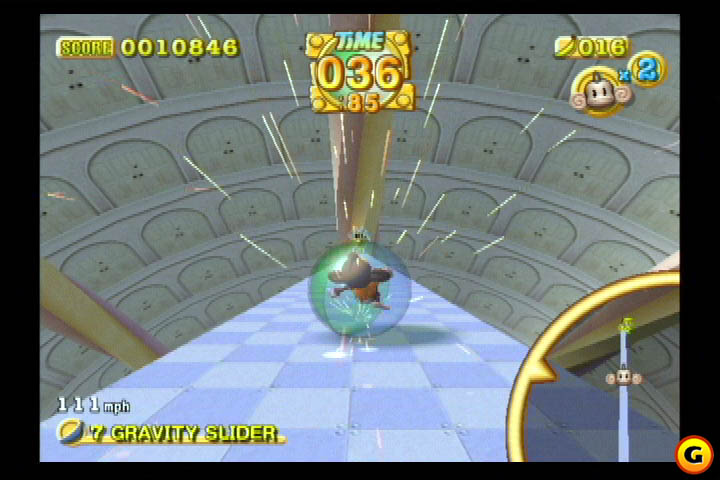
Particle Effect: The definition for this one is easier than you may have once thought. Essentially, particle effects are the display of particles (very small pieces of anything) in a game - they could be sparks flying as a result of friction, snow falling from clouds, etc. Particle effects are used most effectively when shown in large quantities. For a more detailed explanation, click here. (In this example, Super Monkey Ball 2 demonstrates particle effects).
Physics: Essentially, "physics" in video game terminology is the in-game implementation of physical properties, interactions, processes, or laws.
Pixel Shading: Pixel shading is shading done on a per-pixel level to ensure the effect tried by pixel shading is achieved in the most realistic manner. When talking about lighting done on a per pixel level instead of on a vertex level (see the definition of vertex shading), you'll get individual parts of a polygon lit instead of the whole thing. Pixel shading can't be done with the GameCube, but it can be simulated. Rebel Strike (and its water) is the first GCN game to manipulate the hardware to almost perfectly simulate pixel shaders. Everything on the water acts on a per pixel level, such as a rain hitting and reacting realistically the surface. (For a definition of the word "pixel," click here).
Polygons: One of the most common features of 3D games. A polygon is essentially a series of straight lines which enclose an area and form a multi-sided figure that can be filled or moved around as one object. Polygons make up 3D objects, and thus very detailed 3D objects are composed of thousands of polygons.
Pop-up: No, pop-ups aren't those pesky advertisements which take up too much space on your taskbar. Instead, the term "pop-up" in gamer speak refers to an object in a far distance appearing a little too late -- "popping up out of no where" -- so that the game doesn't transition into upcoming environments very smoothly. This is a major problem in racing games when road turns appear out of nowhere so that you are forced to make a sudden turns or put on your brakes. Also known as draw distance.
Progressive-scan: This is a harder concept to understand. Essentially, progressive scan gives video games a crisper, more detailed, and sharper image. How so? On a standard TV, the picture on the TV is changed 50 times, but the picture contains only every other horizontal line displayed, thus every other line is left empty. For example, if there were 200 lines horizontally, only 100 of then would be displayed -- the rest lost. That said, when the picture is being changed 50 times, you're only getting 25 changes that are noticeable. In Progressive Scan, however, your TV displays 50 changes a second (roughly 50 frames-per second) and every one of those 50 frames is displayed 100%. As a result, you have a better image.
Real-Time: Real-Time is a word most often used to describe a battle system within an RPG. Essentially, you're dealing with a system which allows you to attack without stopping to enter commands in a menu. This kind of battle system takes place within the actual game, as opposed to forcing you to go to a turn-based menu. Real-Time also describes another graphical term, cut-scenes. Cut-scenes can take place in real time, using the game's main engine.
Resolution: The word resolution simply describes the amount of detail shown in a game's graphics as a result of a television or monitor's display of graphics. The higher the resolution a television supports, the more detailed the images are. Standard televisions use the 4:3 resolutions, while better televisions can support 16:9 resolution, etc.
Second-party: A second-party company is a company which makes games exclusively for one console because of the console maker's particular investment in that company (but not a majority investment). Examples include Silicon Knights and Brownie Brown.
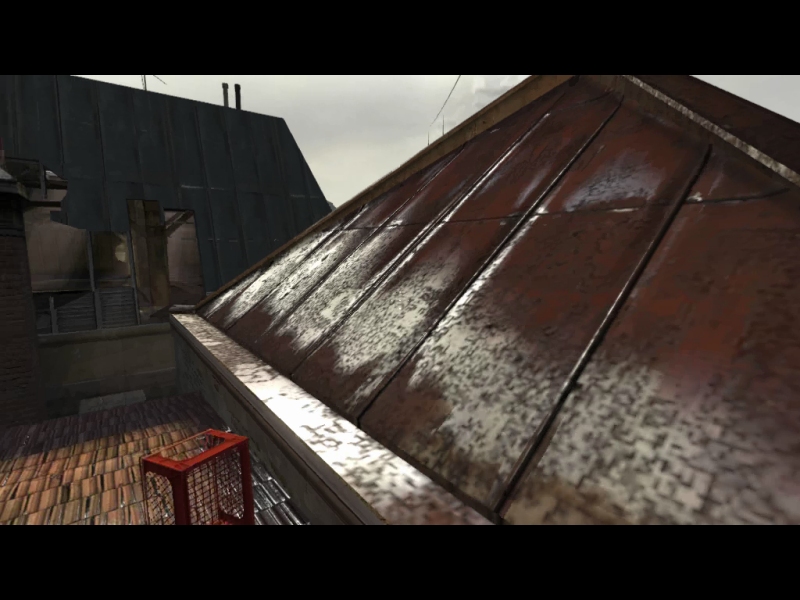
Shine-mapping: Shine-mapping is a texture map that adds a bright glare to a surface... the shine seems to move according to the angle at which you're viewing. (In this example, Half-Life 2 for the PC uses shine-mapping).
Slowdown: Slowdown occurs when the framerate in a game drops, and often interferes with gameplay. See the definition of framerate for more.
System Abbreviations: Here we'll list common abbreviations for systems we use. For consoles, "NES" stands for Nintendo Entertainment System, "SNES" stands for Super Nintendo Entertainment System, "VB" stands for Virtual Boy, "N64" stands for Nintendo 64 and "GCN" stands for the Nintendo GameCube. As for the handhelds, the official abbreviations are "DMG" for Game Boy, "CGB" for Game Boy Color, "AGB" for Game Boy Advance and "AGS" for Game Boy Advance SP, but most commonly, "GB" is used for Game Boy, "GBC" for Game Boy Color, "GBA" for Game Boy Advance and "GBA SP" for Game Boy Advance SP.
Texture Mapping: With texture mapping, graphical patterns are drawn on polygons to make for bumpy or shaded surfaces.
Third-party: A third-party company is a company which makes games for other consoles that aren't their own. There are third-party publishers (the people who put out the games), and third-party developers (the people who actually create the games). Sometimes a publisher is also a developer (thus, it makes its own games), and third-party publishers usually produce games for multiple platforms.
Turn-based: The word "turn-based" refers to a type of battle system in an RPG. In turn-based RPG's, you battle and fight through a series of menus (for instance, you choose an attack with which to strike an enemy). This is the opposite idea of real-time RPG's.
Vertex Shading: When a game uses vertex shading, it uses a technique which illuminates entire polygon surfaces with light instead of simply illuminating smaller areas (specific pixels) on that surface. Metroid Prime used vertex shading well.
Contents:
- I. About the Site - Structure and Policies
- II. About the Site - Content
- III. About the Site - Epilogue
<< Previous
Next >>
|

 Main